
What we generally refer to as the “Prairie State Coal Plant” is officially known as the Prairie State Energy Campus, which includes a coal-fired power plant (1,600 MW) co-located with a coal mine in southwestern Illinois. The plant is the youngest and biggest coal plant in the state, and it emits more air pollution than any other source in Illinois. The plant is also one of the nation’s youngest coal plants, and it consistently ranks as one of the top 10 biggest sources of planet-warming carbon dioxide in the entire US. The facility is owned by public power providers (e.g., municipal electric utilities and rural electric cooperatives), and this unique ownership structure has caused considerable difficulty for its owners and for the state of Illinois’ decarbonization goals.
Prairie State Coal Plant and Lively Grove Mine General Information
- Location: Washington County, Illinois, northeast of the Village of Marissa
- Coal plant size: The coal plant has two units, both 800MW.
- Ownership: The coal plant and coal mine are owned by nine public power agencies serving 277 municipal electric utilities and rural electric cooperatives, across eight states. As described in the timeline below, the facility was originally developed by coal company giant, Peabody Coal, and sold to these public power agencies.
- Facility development cost: In the early stages of development (~2004), the facility was projected to cost $1.8 Billion (source). By the time it became operational in 2012 the costs had ballooned for the facility and ultimately exceeded $5 Billion (source).
- Mining method: The Lively Grove Mine is an underground coal mine that utilizes the room and pillar method.
- Coal production: In 2024 the mine produced 6,817,740 tons of coal.
Key Dates
2001
- Peabody Energy (Peabody) began an “aggressive campaign to induce joint municipal power agencies in states throughout the Midwest to participate in the project…” (source)
2005
- In April 2005, the Illinois Environmental Protection Agency issued the final Prevention of Significant Deterioration (PSD) “construction” air permit, required to regulate air pollution during the construction of the facility. Following the issuance of the PSD, environmental groups, led by Sierra Club, appealed and challenged the permit arguing that it failed to analyze Best Available Control Technology (BACT) and air quality standards for sulfur dioxide and ozone. The challenge was not successful and the construction proceeded. (source)
2007
- Peabody succeeded in “selling approximately 95 percent of the ownership interest in the project to joint public power agencies in eight states.” (source)
2012
- The coal plant began commercial operation on June 12, 2012. (source)
2014
- Batavia residents file a ratepayer class action lawsuit alleging “negligent misrepresentations with respect to the construction, operation, and other aspects of the Prairie State Energy Campus and the cost of electricity generated there.” (source)
2016
- Peabody sold its remaining 5.06% share in the project. (source)
2021
- In March 2021, IEPA issued a violation notice for exceeding particulate matter emissions limits. (source)
- The Climate and Equitable Jobs Act passes, establishing timelines for the coal plant to reduce its carbon emissions by 45% by 2035 and by 100% by 2045. (source)
2022
- In January 2022, the Illinois EPA issued a notice of violation for exceeding mercury emissions limits. (source)
- The Prairie Research Institute published a Front End Engineering Design (FEED) study on outfitting Unit 2 with carbon capture technology. (source) The FEED study indicated a $2.04B price tag with an additional $176M for annual operating and maintenance costs for a carbon capture project on Unit 2. These costs also don’t include the property and income taxes, insurance costs, or the costs to transport and permanently sequester the CO₂.
2023
- Prairie State asks for responses, by a January 2023 deadline, to a solicitation for a “Developer / Operator (D/O) to design, construct, maintain and operate a facility in Illinois that captures carbon dioxide (CO₂) from the flue gas of the PSGC power plant to beneficially re-use and/or permanently sequester underground in geologic formations.” (source)
- In March 2023, the IEPA issued a violation notice for exceeding sulfur dioxide emissions limits. (source)
- In March 2023, Sierra Club filed a lawsuit against Prairie State alleging they were operating “illegally” due to a lack of a Clean Air Act Permit Program (CAAPP) operating permit. (source)
- In May 2023 the IEPA issued a violation notice for failing to conduct periodic performance testing for particulate matter. (source)
2024
- In early 2024, the Illinois Municipal Electric Agency (IMEA), one of the nine public power agency owners of the coal plant, presented its 32 members with an offer to extend their contracts with IMEA. Their current contract expires on September 30, 2025 and IMEA was offering an extension from October 1, 2035 to May 31, 2055. IMEA gave its members until April 30, 2025, to accept or decline this offer. (source) We share a few updates about this contract renewal process in different communities in the timeline below, but it is in no way a comprehensive timeline.
- On December 5, 2024, as one of the results of Sierra Club’s 2023 legal action, the Illinois Pollution Control Board issued an order directing the Illinois EPA to “issue a draft permit or a refusal to grant a permit within one year of Prairie State filing its new CAAPP permit application. The Board also directs IEPA to issue a final permit, if it decides to issue a draft permit, within two years of Prairie State filing its new CAAPP operating permit application.”
2025
- By the April 30 deadline for IMEA contract renewal, 27 of the IMEA members had signed the early contract renewal. (source) This number had risen to 29 by July. (source)
- On August 11, the Village of St Charles City Council’s Government Services Committee voted against renewing the IMEA contract. (source)
- On August 19, the City of Naperville, the biggest IMEA customer, voted to authorize city staff to negotiate a new contract with IMEA, while also allowing the city to seek proposals from power providers on clean energy options. (source)
- In December the Illinois EPA issued a draft CAAPP operating permit and announced public hearings and public comment periods.
2026
- On February 3, the City of Naperville’s city council voted to pause contract negotiations with IMEA. (source)
- In early February the Illinois EPA held three Public Hearings about the draft CAAPP operating permit. Written comments on the draft CAAPP operating permit are due March 9.
Coal Ash at the Prairie State Coal Plant
The Prairie State Coal Plant creates massive amounts of coal ash, the byproduct left behind after burning coal. Despite re-using coal ash, their coal ash landfill is already storing >23 million cubic yards of coal ash, after just 14 years of operation. Prairie State’s most recent groundwater data for the most dangerous coal ash pollutants, such as arsenic and lead, is from 2018 because Prairie State has gamed the system and no longer monitors for those pollutants. Per a 2018 report, Prairie State landfill “should be in assessment monitoring because calcium, chloride, sulfate, and total dissolved solids all appear to be significantly elevated in downgradient wells” but Prairie State has manipulated the monitoring and statistical evaluations and evaded the more intense scrutiny.. You can find out more about their coal ash in our fact sheet.
Air Pollution Emissions at Prairie State Coal Plant
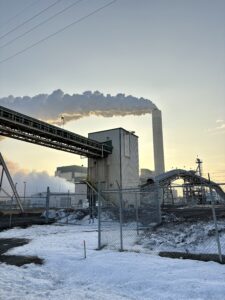
The Prairie State plant is Illinois’ largest stationary source of air pollution in Illinois. In contrast to most coal plants in the state, Prairie State uses Illinois-mined coal with elevated sulfur content, contributing to relatively higher levels of air emissions and underscoring the need for stronger pollution controls. According to a 2023 study, Out of Control: The Deadly Impact of Coal Pollution, the air pollution from the Prairie State Coal Plant contributes to 76 premature deaths per year.
Despite being the state’s biggest stationary source of air pollution, the Prairie State Coal Plant has been operating for 14 years without a CAAPP Operating Permit. As a result of a 2023 Sierra Club lawsuit, IL EPA issued a draft permit in December 2025.
We have downloaded 2023 air pollution data from the USEPA into this spreadsheet. We have also summarized some of the 2023 data below.
Carbon Dioxide (CO2) (12,434,140 tons) and Methane (CH4) (2,873,753 lbs): The plant emits more carbon dioxide and methane than any other sources in Illinois. CO2 and CH4 aren’t pollutants that harm our lungs, they are greenhouse gases that are reshaping the climate that the next generation will live in. Methane is a very potent greenhouse gas, 28 times as potent as CO2 at trapping heat in the atmosphere.
Sulfur Dioxide (SO2) (9,280 tons) and Nitrogen Oxides (NOx) (3,924 tons): The plant emits more SO2 and NOx than any other sources in IL. These pollutants contribute to the formation of ground-level ozone (smog) and fine particulate matter (soot), both of which damage lungs and trigger asthma attacks. The state of Arkansas and the National Park Service have asked the Illinois EPA to look into decreasing haze forming pollutants (NOx and SO2) from the Prairie State Coal Plant (source).
Mercury: Between March 29 and May 1, 2021, Prairie State violated the federal rule governing mercury emissions for plants of its type and size. Prairie State did not report this violation until July 2021, and even then the report was missing important information about the operation of its monitoring equipment. Mercury is a powerful neurotoxin that damages the brain and nervous system, especially in babies and young children. Coal plant mercury pollution contaminates rivers and lakes, and certain populations. Mercury pollution is why Illinois families are warned to limit how much fish they consume from our rivers and lakes.
LOCAL GRASSROOTS ACTION ON PRAIRIE STATE
Robust grassroots efforts have arisen in many of the communities that get their power from the Prairie State coal plant. These community-led efforts have organized people to engage in state energy legislation, play a role in power supply contract decisions, and generally educate the public and community leaders about the need for transparency and action around Prairie State.
In particular, a coalition of local groups – including the Naperville Environment and Sustainability Task Force (NEST), the League of Women Voters of Naperville, First Congregational UCC Naperville, Accelerate Climate Solutions and Green Scene North Central College – launched the “Say No to Coal Consortium” in Naperville to organize around the IMEA contract renewal decision. The Clean Energy Alliance of Naperville also documents and shares information about IMEA and the Prairie State Coal Plant. In St. Charles, efforts on energy issues, including Prairie State, have been led by a group called Tri-Cities Clean Energy, which also connects folks in Batavia and Geneva. In Winnetka, residents and advocacy groups organized the Winnetka Future Energy Coalition (WFEC) to bring attention to the high stakes IMEA contract extension. In Highland, Illinois, the Greater Highland Area Concerned Citizens have long organized around issues related to the Prairie State facility.
NEWS STORIES AND REPORTS ABOUT THE PRAIRIE STATE ENERGY CAMPUS
- 2014, August. Chicago Tribune: Class-action suit filed over Batavia energy deal.
- 2015, Institute for Energy Economics and Financial Analysis Report: The Truth About Prairie State Energy Campus (Part 1): Failing, Year by Year
- 2021, RMI Report: Transition Opportunities for Prairie State Energy Campus
- 2021, June. Inside Climate News: As Illinois Strains to Pass a Major Clean Energy Law, a Big Coal Plant Stands in the Way
- 2022, Prairie Research Institute Study: Front End Engineering Design (FEED) study on CO2 Capture Technology
- 2023, March. Canary Media: Troubled Illinois coal plant never received an operating permit, ran ‘illegally’ for over a decade, lawsuit says
- 2024, May. Chicago Tribune: Naperville, St. Charles, Winnetka and dozens of other communities urged to double down on coal
- 2024, October. Environment America: Who is the top climate polluter in Illinois?
- 2025, April. Belleville News-Democrat, Will Bauer: Environmental group and metro-east coal plant agree to dismiss federal lawsuit
- 2025, April. Bloomberg Law, Shayna Greene: Sierra Club Drops Illinois Coal Plant Clean Air Act Lawsuit
- 2025, August. Chicago Tribune: St. Charles City Council rejects contract extension with coal-reliant electricity provider
- 2026, February. Chicago Tribune: Naperville council votes to pause contract talks with electricity provider IMEA