Wetlands are one of nature’s quietest—and most crucial—maintainers. They’re also in danger of disappearing entirely due to continued federal rollbacks and the resulting negative effects, including development and pollution.
PRN’s River Health and Resiliency Organizer, Nina Struss, grew up in and eventually returned to the Quad Cities area, which is home to several wetland complexes. Here she shares her thoughts about wetlands and her ongoing work with northwestern Illinois communities to protect and preserve these essential bodies. Learn more about Nina’s work here.
Wetlands Are Healing
My background is in nutrition. One of the first times I took a tour of Nahant Marsh (just across the Mississippi River in Davenport, IA), the education center’s executive director explained that wetlands are nature’s kidneys; they work to filter out pollutants that enter our water supply, eventually delivering a cleaner product to our rivers and subsequently our oceans. That drove home how vital their role is in a healthy landscape. Not only that: They’re also an incredible resource for flood protection. Most of our rivers are no longer able to meander freely, so relying on wetlands as pockets for flood protection is critical.
Wetlands Are Steadfast
Rivers are about connection. They connect cities and towns to one another. Bridges span rivers to connect land masses. Festivals and markets connect people at riverfronts. Wetland areas, on the other hand, are literally more in the background, and are not as often frequented or even seen.
This is why more robust conversations—and in some cases, active preservation—are key right now for the wetlands we do have remaining in the Quad Cities. I believe that those who have been involved in conversations around wetlands locally understand their place in the ecosystem of preservation, and they prove to be fierce advocates for protecting these natural areas.
An example of this: Nahant Marsh used to be a sportsman’s club, and was ultimately cleaned up through dedicated efforts from federal, state, and local organizations. Despite high levels of lead in the marsh, clean-up efforts were successful to the point where wildlife and plant life began to flourish once again. This wetland has shown drastic improvements in water quality over the years, too: staff have the data to prove it. Seeing this flourishing wetland after learning its origin story inspires me to find more opportunities to take wetlands from just surviving to thriving in our communities.
Wetlands Are Essential
My biggest fear for the loss of wetlands in our Illinois landscape is the loss of water—and not just that water that sits within the wetlands. With the shifting climate leading to more frequent and intense rainfalls, we’re at higher risk of losing that water to our sewers than being able to conserve the resource within the ground, whether in the form of rain gardens, native/prairie landscapes, or wetlands. The fewer pockets of wetlands we have across our state, the greater loss of water we’ll see over the next several years—a scary situation during a time when water availability is said to be decreasing.
Wetlands are Community
Fortunately, community members in the Quad Cities area are paying attention and are understanding the value wetlands bring. A 2025 Clean River Advisory Council survey of community members revealed that those surveyed consistently ranked wetlands and/or “protecting places that flood” as a top-3 for every priority neighborhood on both sides of the river. People want these areas and what they have to offer, and value their protection.
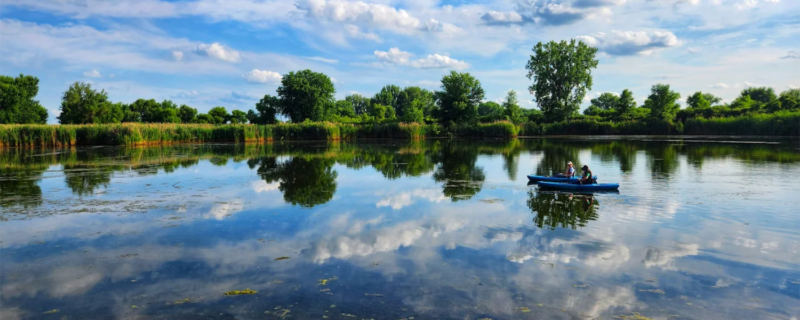
Illinois has tragically lost most of its wetlands, so it’s important that people get out and experience a wetland however they can to better understand how meaningful taking care of those that remain really is. Learning a wetland’s story and understanding the power behind that small (or big!) pocket of water enables us to truly advocate for our wild places and the wildlife that call them home. We just need to get out there.
What You Can Do
Given recent rollbacks of federal wetland protections, now is the time to push state legislators to protect the Illinois wetlands we still have. Tell your legislators to cosponsor the Illinois Wetlands Protection Act (HB3596/SB2401) today.