
The transition to clean energy is critical to protecting public health, clean water and air, and reducing the worst of climate change. While conversations often focus on renewable energy sources, like wind and solar, achieving a clean energy future will require substantial investments in battery storage, energy efficiency, and expanded and improved transmission infrastructure.
Transmission is the movement of large amounts of electricity over long distances through high-voltage power lines. Wind and solar projects are often located in remote or distant areas, and transmission lines are critical for delivering that electricity from the point of generation to the homes, businesses, and industries where it is needed.
According to the National Wildlife Federation’s policy platform on clean energy transmission, “To meet our climate goals—and provide affordable and reliable clean energy to our communities —electric transmission capacity must more than double within this decade.” As Illinois’ NWF affiliate, Prairie Rivers Network, like NWF, “is committed to accelerating America’s clean grid buildout and protecting people and wildlife through responsible investments in clean energy transmission.”
What is Happening in Illinois?
Several major transmission projects are underway in Illinois to improve grid reliability and integrate more renewable energy resources. Illinois also has a new law shaping this work. The Clean and Reliable Grid Affordability Act, which took effect in June 2026, pushes the state to get more transmission capacity out of existing lines, study whether Illinois should have its own grid operator, and produce Illinois’ first statewide long-term energy plan.

The electric grid is managed in Illinois by two “regional transmission organizations” (RTOs), including Midcontinent Independent System Operator (MISO) in central and southern Illinois and across much of the Midwest and South, and PJM Interconnection (PJM) in northern Illinois and much of the Mid-Atlantic region. These RTOs are responsible for planning and approving transmission projects in cooperation with state regulators (e.g., Illinois Commerce Commission), which decide where the lines go, and utilities (e.g., Ameren and ComEd), which build them. Transmission projects seek to improve connection both within these RTOs and between them.
Two major transmission project portfolios in central & northern Illinois were planned through MISO’s Long-Range Transmission Planning (LRTP) process.
- MISO LRTP Tranche 1: Approved in 2022, the Tranche 1 projects in Illinois are known as the Central IL Grid Transformation Program. In 2026, construction is beginning alongside final routing and environmental pre-engineering for the project, which will largely be built along existing corridors. Targeted outreach to agricultural landowners is also underway, and the projected in-service date is 2029.
- MISO LRTP Tranche 2.1: Approved in late 2024, the Tranche 2.1 projects include three projects in the north and north-central part of Illinois, anchored by a new 765 kV backbone. In 2026, these projects are undergoing subregional routing evaluations and initial engineering studies. Their state-level ICC certificate filings are expected in 2027, and the lines are slated to be in service in 2034.
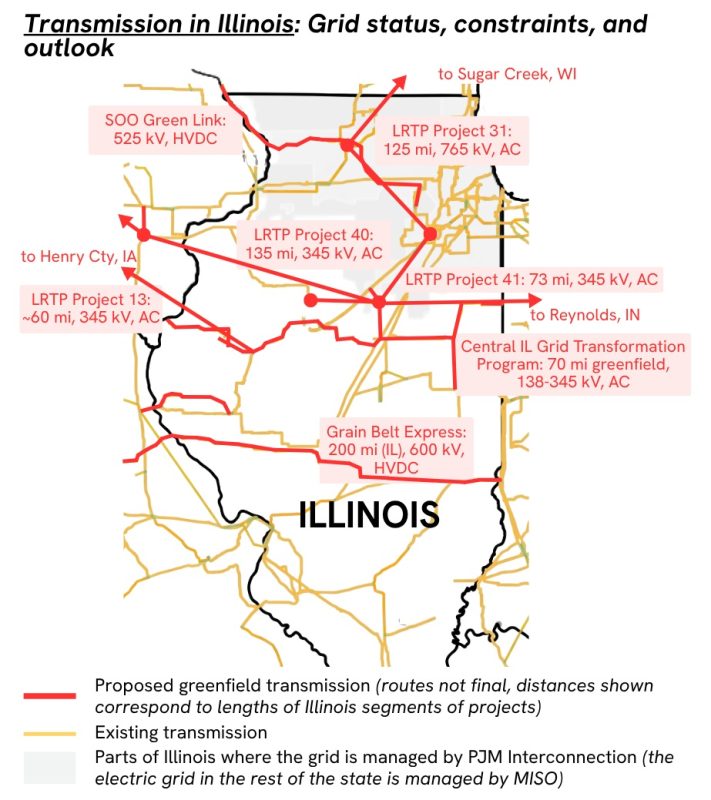
Two other projects were proposed independently of MISO’s planning process.
3. Grain Belt Express: A January 2026 Illinois Supreme Court ruling reinstated the project’s state permit. Active development, including land acquisition and easement negotiations, is continuing in 2026.
4. SOO Green Link IL terminus: Pre-construction and final technical modeling are moving forward in 2026. Site work and engineering are projected for 2028, and the project’s operational target is 2031. This line runs underground along an existing railroad corridor, and because it is privately financed and not seeking eminent domain, it does not need state siting approval in Illinois.
How can climate advocates and community members get involved?
Climate advocates and community members can play an important role in shaping transmission projects by participating in planning and permitting processes with local governments, state agencies, utilities, and regional grid operators (MISO and PJM) and advocating for responsible development that meets our clean energy goals while protecting cultural and natural resources. Timing matters here. Developers hold public open houses as routes take shape, but these are not always well advertised, and once a project receives its state approval the route is effectively set. Watching for those meetings and asking developers for advance notice of them gives communities a say while routes can still change.
NWF’s fact sheet, Transmission in Illinois: Drivers & Engagement Pathways, provides a detailed list of the different stakeholders associated with different project considerations, from wildlife and habitat to land use and agriculture, to MISO/PJM interregional system needs. For example, the Illinois Department of Natural Resources, Illinois Nature Preserves Commission, and local environmental groups will be engaged to deal with issues related to threatened and endangered species and protected areas along proposed transmission lines. Local agricultural landowners and the Illinois Department of Agriculture will be working to ensure prime farmland soils are restored. Beyond flagging concerns to those agencies, community members can ask for specific protections, e.g., routing that aligns with the Illinois Wildlife Action Plan, wildlife-safe line design and seasonal construction limits, and using existing corridors or upgrading existing lines instead of cutting new routes. Advocates can also push for early notice to affected residents, community benefits commitments from developers, and transparency about how project costs show up on local bills.
What about Data Centers and the POWER Act?
The energy demands of data centers are presenting challenges for the electric grid, including for energy generation and transmission. It is important to note that the Tranche 1 and 2.1 projects described above were planned to meet Illinois’ decarbonization goals and to ensure reliability and affordability, and they were not planned to meet the growing energy demands of data centers. An analysis from the Union of Concerned Scientists found that overall electricity demand could increase by more than half by 2035, and data centers will account for up to 65 percent of that growth. Data centers built in any state in PJM and MISO regions have the potential to impact ratepayers in Illinois. The POWER Act directly addresses skyrocketing electricity costs driven by unprecedented data center demand. Under the proposed bill, data centers will be required to bring new clean energy resources to the grid and will be prohibited from shifting infrastructure and capacity costs onto everyday consumers.
Illinois’ Path Forward
Illinois’ residents, no matter their electricity provider, want reliable and affordable power. We also all want clean air and water, which require clean power to reduce pollution. And while everyone deserves an equitable and resilient electric grid to power their best lives, we have to invest today for the grid we want (and will need) in 2050. New lines are vital to keep up reliability amid more frequent weather extremes and periods of high energy demand. These projects will get solar, wind, and battery storage projects online so that fossil fuel plants can be retired and stop polluting. In short, transmission upgrades support the transition to clean energy by keeping renewable investments growing in Illinois, ensuring a reliable, affordable, clean, equitable, and resilient electric grid for our future.