Prairie Rivers Network is deeply concerned about the health of trees, ecosystems, and communities across Illinois due to continued exposure to drifting pesticides, these include herbicides, fungicides, insecticides, etc.
Beginning in 2018, Prairie Rivers Network created the Tree and Plant Health Monitoring Program to ensure the ongoing monitoring and documentation of the health of ecosystems under the pressures of habitat loss, pesticides, and climate change. At the time, there was very little data and virtually NO ecological monitoring on the short-term or long-term ecological impacts of pesticide, specifically herbicide and fungicide, drift. To our knowledge, PRN’s monitoring data remains the most robust and perhaps the only data set of its kind.
We’ve been documenting this damage for years. You can read our 2018-2019 Tree and Plant Health Monitoring Report. We also co-published a report with the National Wildlife Federation and the Xerces Society for Invertebrate Conservation titled Drifting Toward Disaster: How Dicamba Herbicides are Harming Cultivated and Wild Landscapes.
In July 2024, we released the results of six years of monitoring in the report, Hidden in Plain Sight. More than 99 percent of the sites we monitored exhibited signs of herbicide exposure, and more than 90 percent of trees tested had detectable residues of pesticides (herbicides and fungicides). The report shared the stories of people whose lives have been impacted by this pesticide drift.
Governmental agencies, particularly the Environmental Protection Agency, the Department of Agriculture, the Department of Health and research institutions should be doing more to document and understand the impacts of pesticide drift and chemical trespass to our natural areas, backyards, gardens, and public spaces. Additionally, these agencies and institutions should be investigating the potential impacts of airborne and waterborne pesticides on human health.
In 2025, we expanded efforts and incorporated the monthly collection and analysis of leaf tissue and monitoring bands at 10 locations across the state. This was done in an effort to better understand the frequency and types of pesticides that are trespassing to public spaces. Our 2026 addendum to Hidden in Plain Sight, Pesticide Drift in Public Spaces, summarizes those additional findings.
Pesticides in Public Spaces explores the frequency and distribution of pesticide drift in the places where children and adults play and learn. Ten parks or schoolyards were sampled across the state during the 5 warm weather months in 2025. Over this period of time, every site and sampling event demonstrated the presence of herbicides and/or fungicides. Herbicide drift is nothing new, but the continued trespass and associated damage caused by these pesticides is taking a huge toll. It is impacting the health of our natural spaces where wildlife live and people recreate, the livelihood specialty growers, our ability to have beautiful healthy gardens and yards, and the quality of the air we breathe and our very health. If you would like to share your story of how drift has impacted you, your farm, your home, your favorite place, or your health with PRN, use this form to do so.
DAMAGE TO ILLINOIS’ RECORD-SETTING POST OAK
Many trees are showing symptoms of exposure to herbicide drift and volatilization (think evaporation and movement), including our state record-setting Post Oak. It is a magnificent tree whose canopy extends 100ft and has a trunk more than 17 ft in diameter. Oaks are keystone species in Illinois, and are vital to the health of our ecosystems. Oak trees are host plants for hundreds of species of insects and offer important food resources for migratory birds and other wildlife. Since 2018 we have been monitoring and documenting herbicide damage. In 2019 we began collecting and analyzing leaf samples for pesticide residues. All 23 samples that have been collected from this record setting tree have had residues of pesticides, including herbicides and fungicides.
RECOGNIZING AND REPORTING DRIFT
In recent years, Illinois has been dealing with significant increases in crop, tree, and plant injuries. These injuries are symptomatic of exposure to herbicides commonly used in agriculture and lawn management. Even moderate levels of repeated and/or chronic exposures can injure plants and have not only visible, but also unseen effects on our environment.
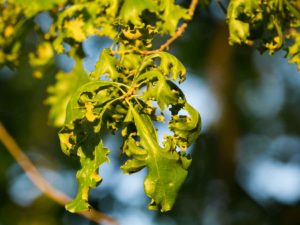
Symptoms of herbicide exposure are much easier to observe than symptoms of insecticide or fungicide exposure. Drifting and trespassing herbicides often cause visible injury to the leaves, stems, and flowers of plants. Among the most easily recognized symptoms are cupped, curled, stunted, or yellowish leaves. Paying attention to what is happening on your property and documenting and reporting symptoms you see extremely important. The video below is designed to help people recognize symptoms of pesticide exposure in crops, trees, and other wild plants and provides information on how and where to document or report symptoms. For another helpful resource on understanding what symptoms look like visit our photo library.
REPORTING SYMPTOMS OF HERBICIDE DAMAGE TO IDOA
If you notice herbicide injury on your plantings or on non-target species, you can report it to the Illinois Department of Agriculture at “Pesticides: Uses & Misuses.”
Also, call IDOA’s Bureau of Environmental Programs at 1-800-641-3934 (voice and TDD) or 217-785-2427 for a complaint form. Complaints must be received by the IDOA within 30 days of the incident or within 30 days of when the damage was first noticed. Complaints filed after that will be kept on record, but no administrative action can be taken.
It is becoming clearer with each passing year that the current pesticide complaint system has numerous limitations and problems. The complaint process is not set up to address all cases of potential herbicide-related injury to plants. However, it is currently the primary way IDOA collects information regarding pesticide-related injuries and therefore remains an important (and the public’s only) method of documenting suspected injury with the IDOA.