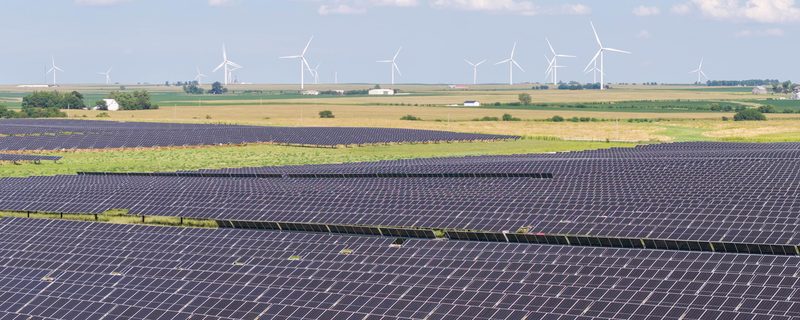
As solar farms expand across the Illinois landscape, the importance of proper siting and planning has become a hot topic, prompting local leaders to ask: “What’s our role in all of this?”
Recorded on August 25th in collaboration with the University of Illinois, Energy Siting and Policy: What Local Governments Need to Know was the first in a series of webinars focused on renewable energy; stay tuned for upcoming topics including geothermal, solar, and wind. Read on for a summary, and you can always watch the full episode on our YouTube channel.
Kicking off the Resilient Communities series of renewable energy-focused webinars, the Climate Jobs Institute and Illinois Extension set the stage by sharing updates on state energy policy and local clean energy permitting processes in the context of state law. This renewable energy series is timely, as utility-scale solar and wind developments are expanding into communities across the state, leaving local governments to navigate questions about their evolving role in reviewing these projects. This webinar provides the foundational overview of the state’s energy policies and procedures to help local governments navigate renewable energy developments. Subsequent webinars within the renewable energy series will build on this overview by diving deeper into geothermal, solar, and wind projects.
Energy Policy—Climate Jobs Institute
Linda Larsen, the Associate Director of Research at the Climate Jobs Institute, provided the audience with a state-level overview of what’s driving the transition to renewable energy, including concerns about climate change, desires for energy independence, state policy, and cost-reducing technological advances in clean energy. She highlighted CJI’s Electric Power Capacity Dashboard, which allows users to better understand the status of operational and retiring electric power plants, identify areas where renewable energy power plants are being proposed, and consider workforce planning needs. Linda walked us through graphs showing states’ generating portfolios, highlighting the fact that some states are simply adding renewable energy to their portfolios, while progressive states like Illinois are actually transitioning away from fossil fuel-powered electrical generation. Pointing to policies like the 2021 Clean and Equitable Jobs Act (CEJA) and the 2026 Clean and Reliable Grid Act (CRGA), she noted that state incentives have catalyzed the transition to clean energy while federal rollbacks and increasing energy demands from data centers create a level of uncertainty.
The Climate Jobs Institute was created by the Illinois General Assembly in 2021 to support a just energy transition within the state, ensuring a strong, equitable, and zero-carbon economy while supporting impacted workers and their communities. CJI has created several resources and tools to help communities better understand and plan for the energy transition, including the CEJA Map, Illinois Clean Jobs Inventory, and Regional Clean Energy Data Packets.
Energy Siting—University of Illinois Extension
Andrea Wagner is a statewide sustainable energy specialist at the University of Illinois Extension, where she supports communities with making informed energy decisions. Her presentation gave our audience a broad overview of the policies guiding renewable energy projects in Illinois.
Andrea jumped straight in by referencing the controversial 2023 Siting Bill, which prohibits counties from outright banning utility-scale wind and solar developments and sets maximum allowable restrictions, lays out vegetative screening, and provides natural resources reviews. County codes related to commercial wind and solar energy facilities across the state were then amended with the passage of CRGA, which added siting standards for battery energy storage systems (BESS). Andrea stressed the importance of having some form of county zoning ordinance to ensure communities have mechanisms to regulate standalone energy storage systems, if they so choose. She showcased recent policy changes local governments should keep in mind, including maximum special use permit fees, required setbacks for standalone energy storage systems, changes to public hearing timelines, and that screening is now only required between solar and non-participating residences.
Since utility-scale wind and solar projects generally fall under a special use permit, she also gave the audience an in-depth look at what these permits entail, including—but not limited to—public hearings, compatibility analysis, and findings of fact. The University of Illinois Extensions Energy Team has several resources available to communities navigating a renewable energy development including their Energy Planning For Municipalities, Energy Safety Tips, and Renewable Energy Workshops.
Navigating a Clean Energy Future
As renewable energy developments pop up across the state, local governments are encouraged to collaborate with local Illinois Extension offices, zoning officials, and other state resources to ensure their communities are receiving the maximum benefits. If your community is interested in learning more about clean energy, consider following the Resilient Communities Webinar series as we explore geothermal, solar, and wind in the following months. If you miss an episode, you can always find the recordings on our YouTube channel.