
No POWER Act This Spring
Our legislators in the Illinois General Assembly had a chance to pass the POWER Act this May and create common sense safeguards to protect our pocket books, our water, our climate goals, and our communities from the impacts of data centers.
It wasn’t seriously considered.
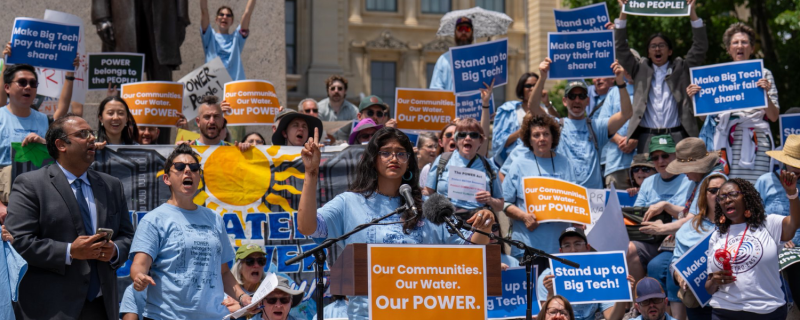
The POWER Act is supported by the majority of Illinois voters, according to recent polling. PRN and partners have been holding meetings across the state to hear from the public about data centers, and it is clear that data centers are very unpopular. Over the weekend, 600 people came to Springfield from across Illinois to urge the legislature to support the POWER Act.
Not only did the legislature adjourn without passing the POWER Act, but the legislature affirmed their commitment to tax breaks for Big Tech—incentives that gave the industry a billion dollars in tax breaks in Illinois in 2024.
The legislature chose data centers over the public interest.
The move also went against Governor Pritzker, who called on the legislature in his State of the State address to pause the data center tax incentives until reasonable statewide protections could be put in place.
Some legislators pushed to pause the tax incentives. More than 40 legislators signed a letter calling on legislative leadership to pause the data center subsidies. Legislative leadership did not listen. Instead, they listened to their campaign donors.
Pausing the data center tax incentives would have forced data center developers and their allies in labor to come to the negotiating table with us. It would have shown the data center industry that the Illinois legislature was ready to protect the public from data center impacts.
In 2026 alone, we’ve seen multiple enormous “hyperscale” data centers approved in Illinois. The projected resource consumption is alarming: over 4,500MW of electricity (that’s more than Chicago’s energy demand) and an undisclosed amount of water. In many cases, project approval was ushered through with little public input and transparency, making it difficult for the public to fully understand the long term impacts on energy, water resources, and the community.
Several additional proposed projects are in front of local decision makers, and more projects are in the pipeline. Our next opportunity to pass the POWER Act is during this fall’s legislative “veto” session. By then, how many more will be approved in back-room deals without the safeguards for our energy rates, our water, our air, or our communities?
We’re not done. We need the POWER Act, and PRN and our partners are calling the legislature to convene negotiations this June. Join us this summer in attending town halls, writing letters to the editor, attending local zoning and county board meetings, and calling our legislators to take action.