This blog was written collaboratively by United Congregations of Metro-East, Prairie Rivers Network, Faith in Place, and the Illinois Environmental Council.
Article XI of the Illinois Constitution guarantees that “each person has the right to a healthful environment.” The Illinois Environmental Protection Agency (IEPA) Director reminded the audience of this at a recent Fireside Chat event, hosted by the United Congregations of Metro-East (UCM) in East St. Louis. This constitutional promise reflects a core principle of “environmental justice”: that all people should be protected from environmental pollution regardless of race, income, or where they live.
For the people of the Metro-East, environmental justice is not just a concept; it is a lived experience. The Fireside Chat followed a Toxic Tour that showcased the environmental burdens of the area, including flooding, sewer overflows, and industrial pollution. The Metro-East is a portion of southwestern Illinois that sits just east of St. Louis, across the Mississippi River. These environmental injustices are not by accident; they are the result of environmental racism, fueled by historic segregation, discriminatory housing policies, disinvestment, exclusion from political decision-making, and lack of enforcement of environmental laws in communities of color.

Toxic Tour
The June 12, 2026 Toxic Tour and Fireside Chat brought together state agencies, community members, nonprofit staff, and elected leaders with the purpose of bringing awareness to communities in environmental crises and collaborating on how to move forward. The events were attended by Illinois EPA Director James Jennings, Deputy Director Amanda Raddatz, and Chris Pressnall, the Manager of the Office of Environmental Justice.
Jalen Williams, the Southern Illinois Organizer with the nonprofit Community Organizing and Family Issues, led the tour, supported by UCM’s Executive Director Darnell Tingle, and community members joined in to share their lived experiences as the tour highlighted flooding, sanitary sewer overflows, industrial pollution, and a long history of disinvestment. The tour focused on the communities of East St. Louis, Cahokia Heights (created in 2021 by the joining of Centreville, Alorton, and Cahokia), Caseyville, and Sauget.
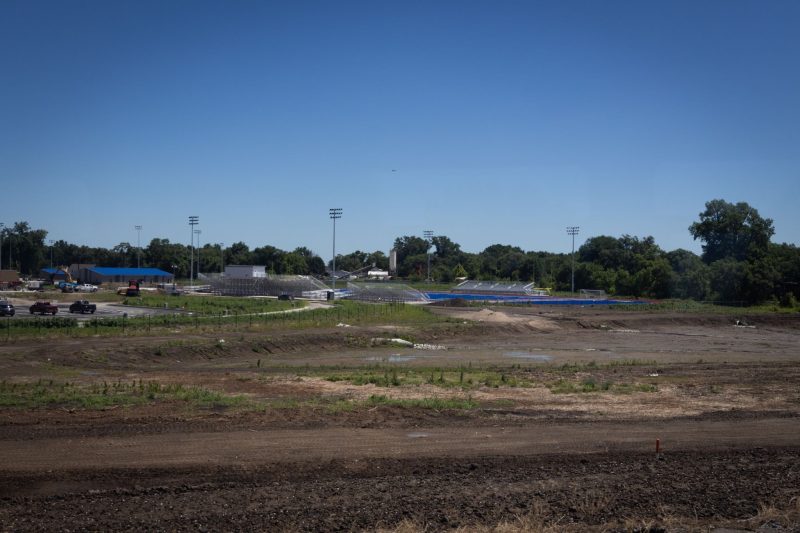
Flooding – The communities visited on the tour are located in the flat and low-lying Mississippi River floodplain. Although they are protected by a levee system, many neighborhoods still experience persistent flooding due to a high water table, poorly drained soils, loss of wetlands, extensive paved surfaces, channelized drainage ditches, and poorly maintained water infrastructure. The lack of investment in infrastructure and maintenance is not something new, it is the result of decades of underinvestment, now compounded by increasingly severe, climate change-driven rain events that are intensifying flooding. In 2022, flooding damaged more than 500 homes across 11 St. Clair County communities and caused an estimated $8.4 million in residential property damage. One example seen on the tour was Harding Ditch, a channelized ditch that has not received the maintenance it needs. Just on the other side of the ditch’s levee, many houses were abandoned due to the recurring flooding. Community members on the tour spoke of the challenges that homeowners face, repairing their homes again and again and often without the help of insurance. In addition to the danger and immediate challenges of extreme floodwaters, repeated flooding can lead to mold growth, decreased property values, and mounting financial and emotional stress.
Sanitary Sewer Overflows – Flooding often intersects with another major challenge that the tour highlighted in East St Louis and Cahokia Heights: sanitary sewer overflows. In particular, East St Louis has a combined sewer, which means it carries both stormwater and sewage in the same pipe. During heavy rain events, aging, undersized, and poorly maintained sewer system infrastructure can become overwhelmed, causing untreated sewage to overflow into local waterways and, in some cases, enter homes through basements and floodwaters. These waters can carry contaminants like E. coli and fecal coliform that are a threat to drinking water and human health. Residents of Cahokia Heights, which includes the former community of Centreville, have been sounding the alarm and sharing their stories, including on the flooded and forgotten website. Both cities have state and/or federal enforcement actions for environmental violations, and both need tens of millions of dollars in funding to address the aging water infrastructure to begin to improve these problems.

Industrial Pollution – Industrial pollution is often concentrated in low-income and Black and brown communities, in areas known as “sacrifice zones.” Environmental Protection Agency (EPA) funded researchers found that across the United States, regardless of income, people of color are more exposed to higher levels of fine particulate (PM2.5) air pollution than white Americans. Perhaps one of the most notorious examples of this in downstate Illinois is the Village of Sauget, originally named Monsanto at its founding in 1926 because it was incorporated by Monsanto Company Executives for lax regulations and low taxes. In the industry-heavy community, tour participants could smell the headache-inducing emissions as the bus passed the industrial sites along Mississippi St. In particular, the Veolia hazardous waste incinerator has long been a source of toxic air pollution. During the tour community members also spoke of health problems including asthma and certain cancers.

Fireside Chat with Illinois EPA
After the tour the group was joined by others, and everyone sat down in the Southern Mission Missionary Baptist Church in East St Louis for a conversation with the Illinois EPA officials. One topic of conversation was the agency’s in-the-works plan to test residents’ homes for bacteria. Director Jennings noted that the agency was finalizing their testing protocol. In the conversations, the Illinois EPA pointed to some limitations in their capacity for enforcement and funding. For example Veolia’s air permit is managed by the US EPA and this year’s state budget has been set. The agency pointed to their “portfolio” of funding that flows through specific grant programs, like the state revolving fund and brownfield clean-up program.
UCM had prepared specific asks for the Illinois EPA, outlined in detail here, that seek an increase in transparent sharing of health data and permits, actionable steps for Cahokia Height’s sewer issues, and consistent direct engagement between the community and the agency. The Director committed to meet with local leaders at least quarterly, hire a staff person whose focus would be the Metro-East area, and said that UCM’s asks were “entirely reasonable” and he looked forward to being able to “carry them out.”

Federal EPA – If this event had been held a year and a half ago, a US EPA Coordinator, appointed to work in the Metro-East and specifically on the Cahokia Heights sewer issue, would have been in attendance. However, that person was reassigned under the Trump-Zeldin EPA, leaving the community without a critical connection to the agency that is in charge of Veolia’s air permit, as well as federal grants that could help address problems. What’s more, the new administration also closed the Office of Environmental Justice and terminated a grant to UCM for air quality monitoring. The federal rollbacks further highlight the need for leadership of the Illinois EPA.
More about UCM and partners
United Congregations of Metro-East’s mission is “to be a powerful faith-based organization committed to combating the root cause of systemic injustice by uniting people and transforming our communities.” They have spent years documenting environmental concerns, educating residents, elevating community voices, and advocating for change.
Prairie Rivers Network is an Illinois nonprofit with a mission to protect water, heal land, and inspire change.
Faith in Place’s mission is to cultivate a powerful multifaith movement working for environmental justice through connection, education, and advocacy.
Illinois Environmental Council’s mission is to advance equitable public policies that ensure a healthy environment across Illinois through collaboration, building power, and advocacy.
Press about the Toxic Tour
Fox2Now Story: Illinois EPA pledges $10M for cleanup amid demands
Belleville News Democrat Story: Illinois EPA takes ‘toxic tour’ through these contaminated metro-east sites