
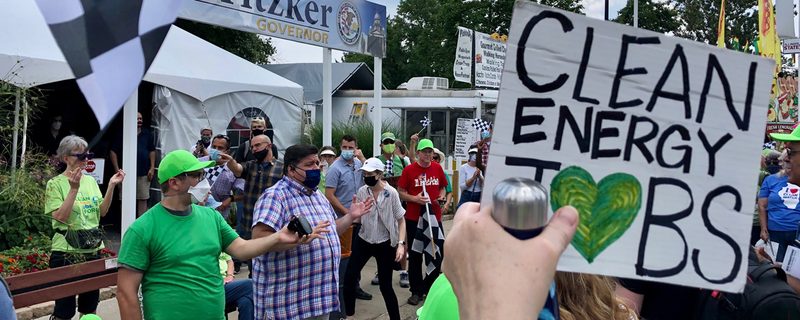
On September 15, 2026, Prairie Rivers Network and our partners at the Illinois Clean Jobs Coalition (ICJC) celebrated the five-year anniversary of the Climate and Equitable Jobs Act, or CEJA.
It took three years to pass this nation-leading climate and clean energy bill, and PRN’s members showed up in tremendous ways to get it done. From community meetings to inform the legislation, to letters to the editor, petitions, rallies, and lobby days, it took a Network to get the bill over the finish line! No Climate, No Equity, No Deal: The Climate and Equitable Jobs Act, featuring PRN’s Amanda Pankau, is a short film about that landmark effort.
While reflecting on the effort to pass the law is important, we also want to share the benefits of CEJA that are reaching people and communities across the state. Check out these five things that are important to know about CEJA’s five-year impact in Illinois:
1. CEJA’s programs offer savings for residents and small businesses.
CEJA created several opportunities to help residents and small businesses save energy (and therefore money) on their electricity bill.
CEJA boosted solar financial incentives offered through the state’s Illinois Shines program, which helps make solar more affordable for residents and small businesses. This state website helps users determine if solar is right for them and provides insight into finding and selecting the right solar vendor. If solar isn’t right for your property, don’t worry! You can go solar without installing solar. It’s true – check out Community Solar, a subscription-based solar program that was boosted by CEJA.
Energy efficiency means using less energy to provide the same outcome; CEJA requires that utilities in Illinois help their customers achieve this. Check out Ameren’s energy efficiency programs for homes and small businesses, and the public sector, as well as ComEd’s energy efficiency programs for homes and small businesses. Finally, CEJA’s Illinois Electric Vehicle Rebate Program offers rebates to income-qualified people on the purchase of new and used electric vehicles.
2. CEJA is supporting Illinois coal communities.
PRN has long been an advocate for coal communities, working alongside them to stop and clean up air and water pollution. During this time of energy transition, we must continue that pollution work, and also ensure that coal communities have new economic opportunities.
Thanks to advocacy efforts from PRN and coal community leaders, CEJA included the Illinois Energy Community Reinvestment Act. This created the Energy Transition Community Grant Program, which has, to date, distributed $120 million to communities impacted by coal plant, mine, or nuclear closures. Each year, PRN offers technical assistance to help communities understand and apply for this grant program. These projects have supported critical water infrastructure in communities, public health efforts, job training, local parks and tourism, and much more.
3. CEJA is creating clean energy workforce opportunities.
CEJA recognized that Illinois’ clean energy transition would require a trained and qualified workforce to build, operate, and maintain new energy infrastructure. Therefore, the legislation launched 14 workforce training hubs in communities across the state to train workers for the jobs of the future, with a focus on bringing underserved communities into the clean energy workforce.
Since then, more than 800 Illinoisans have graduated from these hubs. The CEJA hubs offer training in clean energy careers you might expect in sectors like solar and wind, but training is also offered in electric vehicles, HVAC, manufacturing, and more.
Our partners at the Illinois Environmental Council have held tours of five of the workforce hubs. Read more in their recent blog, 5 Years of CEJA, 5 Tours With IEC. To find the CEJA workforce hub nearest you (or the one that provides the type of clean energy training you are looking for), check out this list.
4. CEJA has led to the growth of renewable energy.
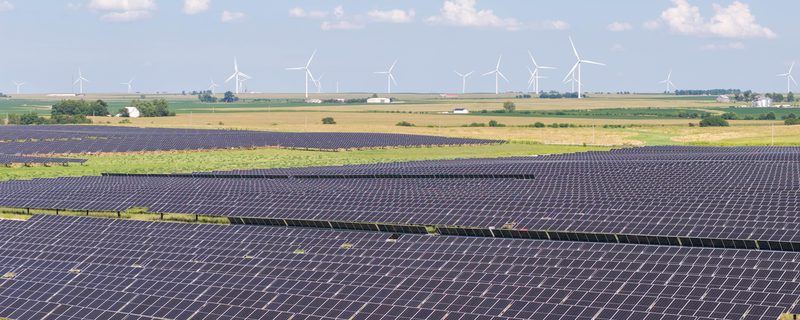
Renewable energy accounted for about 16% of Illinois’ electricity generation in 2024. While that number is still a long way from our 50% by 2040 goal, it was triple the amount generated a decade earlier and CEJA reactivated and doubled the state’s investment in renewable energy! Cumulative solar capacity has skyrocketed from just 40 Megawatts (MW) in 2019 to over 4,500 MW today and 12,500 MW by 2030. Wind capacity has also increased, but at a more moderate pace, from approximately 5,200 MW cumulative capacity in 2019 to 8,200 MW in 2024.
While we haven’t seen any CEJA driven fossil fuel closures yet (those don’t begin until 2030), Illinois has already started to make the move away from coal due to economic and environmental factors. In 2024, coal accounted for only 14% of electricity generation, a drop from 46% in 2009. This results in cleaner air and stops the production of more coal ash, which remains a legacy problem of the coal industry that PRN continues to work to clean up!
5. CEJA has come a long way in five years, but data centers present a new threat to our clean energy future.
CEJA was never meant to answer all the challenges on the path to a 100% clean energy future. In 2025, we worked again with our members and ICJC partners to help pass the Clean and Reliable Grid and Affordability Act (CRGA Act) to expand battery storage. This summer, the state approved incentives to build 600 MW of battery storage, which is over four times the 141 megawatts of utility-scale battery storage currently installed in the state. Additionally, Illinois sits within two regional grid operators, MISO and PJM, and meeting that challenge means investing in transmission and coordinating across and within these regions.
However, all of this progress to expand clean energy and reduce planet-warming emissions in the state is threatened by the rapid growth of electricity-hungry data centers. This challenge requires a specific, thoughtful, and robust response to ensure that an unprecedented technological upheaval does not disrupt Illinois’s progress towards affordable clean energy, and to ensure it doesn’t impact Illinois’s plentiful clean water, and its highly resilient communities. Prairie Rivers Network is working on a statewide policy solution—the POWER Act—and supporting frontline communities impacted by individual projects.
With continued work by the Illinois Clean Jobs Coalition and advocates across the state, Illinois’ policies will continue to guide a clean energy transition that is also being driven by economics and made much more urgent by real-time climate change.