Topic: Wildlife

 
February 11, 2013

Glass Shrimp found in Des Plaines River

In a rare find, freshwater shrimp officially known as Mississippi grass shrimp have been found in the Des Plaines River. Shrimp are an indicator of cleaner water systems, so it’s a good sign that the Des Plaines River’s aquatic habitats are improving. You can see from the photo below why they are also known as glass shrimp. This is the first documentation of this species in Lake County.

Photo by David Argent, courtesy of USGS

Prairie Rivers Network also gets a mention in the same article for our joint statement with the Sierra Club and Openlands criticizing the Illinois Environmental Protection Agency’s decision to grant a wastewater discharge permit to Mississippi Sand, LLC. The permit would allow Mississippi Sand to discharge up to 5.1 million gallons a day of wastewater from its planned mining operation adjacent to Starved Rock State Park, into Horseshoe Creek, which flows through the park. Introducing that much water will likely cause damage to Horseshoe Creek and destroy its low-flow ecosystem.

This decision enables the degradation of the irreplaceable natural and recreational value of Starved Rock. In particular, IEPA’s granting the permit without holding a public hearing to listen and to respond directly to numerous public concerns about the mining operation’s environmental and economic impacts is simply inadequate. Read our full statement here and see our previous article about this issue.

Read the full article in the Lake County Sun-Times. (pdf)                                                           Share this story!

November 19, 2012

Otters are making a big comeback in Illinois!

Today, thanks to diligent, long-term work to reduce pollution, protect wooded areas, and restore land along water bodies, the playful and very photogenic river otter is making a big comeback in Illinois!

Watch this mother river otter as she pulls out onto bank to call for pups, Middle Fork of the Vermilion River (Wabash basin), Illinois.

Once common, the river otter all but disappeared due to pollution, habitat destruction, and uncontrolled hunting. Then as conditions started to improve across the state, the Illinois DNR imported 350 otters from Louisiana, and populations took off. River otters can now be found throughout Illinois.

In fact, the river otter population is doing so well that the DNR has agreed to issue limited trapping licenses. A recent article in the LA Times describes how some aren’t so thrilled with the competition for fish and are making an argument for keeping the population in check.

“Sometimes our efforts have unanticipated consequences,” said Elliot Brinkman, Habitat Specialist, “but the recovery of the river otter should be viewed as an ecological success. The investments we make in the land and water now will continue to pay dividends for years to come.”

Clean water. Healthy rivers. (Too) many otters. Make an investment in more river recovery stories with a donation to Prairie Rivers Network today!


Photo credit: Dmitry Azovtsev, www.daphoto.info

September 28, 2012

Wildlife Habitat in Illinois

Wildlife Habitat Fact Sheet Click on image to read or download

Healthy land makes for healthier, cleaner water! Wetlands, forests, and prairies help control flooding, filter pollution, prevent sediment from being washed downstream, and provide critical habitat for our state’s wildlife.

Prairie Rivers Network’s habitat specialist, Elliot Brinkman, works with private landowners, public land agencies, land trusts, and others to expand and connect the patchwork of natural lands and habitats across the state. The majority of Illinois’ wildlands are located along rivers and streams.

Prairie Rivers Network has actively worked with conservation partners to develop wildlife habitat management plans for portions of the Mississippi and Vermilion River watersheds. These plans reflect the shared goals and priorities of agencies and organizations in each area, and acts as a tool for reaching state conservation targets outlined in the Illinois Wildlife Action Plan. Through this work, we have recognized the need to promote conservation and responsible practices on private lands.

Ninety percent of land in Illinois is privately owned, which means that private lands conservation is critically important for clean water and habitat preservation.

Supported by a recent grant from the Grand Victoria Foundation, Prairie Rivers Network will draw on the best land conservation measures from across the country to craft policy-based solutions for Illinois.

July 24, 2012

Eagles on the Middle Fork

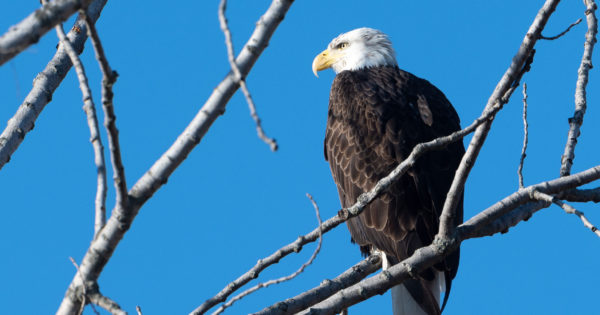
This summer, Vermilion County resident, David Hale, has sent us some great photos of wildlife along the Middle Fork of the Vermilion River. Since the river was protected with a special federal designation in 1989, David has been eyewitness to the return of the animals that make it such a special place. In March of 2010, he noticed an eagle’s nest in a large Sycamore tree along the river. Ever since, he has been monitoring and photographing the eagles along with other wildlife that inhabit the area. We think the story is best told in his words, so the following are excerpts and photos from several email exchanges we’ve had with David. Please stay tuned for updates from the Middle Fork!

[See previous posts from June 11th, June 13th, June 27th, and July 3]

July 15, 2012

Thinkin' about flyin', David Hale

"Thinkin' about flyin'," David Hale

I visited the nest on Tuesday, July 10 and discovered that the oldest chick had returned to hang out near the nest. The other two were out of the nest and on the river bank below it. The bigger of the two was active, drinking water and flying short distances. The smallest seemed alert but wasn’t moving around much. I didn’t know if this was a normal transition from the nest or if they’d simply fallen for some reason. I returned early the next morning and saw that the smallest chick was weak and not moving.

Not sure what to do, I drove to Kickapoo Park and talked to John Hott, the park superintendant, and we decided to try and save it. With the help of John’s wife, we loaded the chick into a small animal crate and took it to the Wild Animal Clinic at the University of Illinois. Unfortunately, it died shortly after being dropped off. The clinic manager said it was malnourished and very dehydrated. It ain’t easy growing up to be an eagle; they have a 50% mortality rate the first year.

The Watcher, David Hale

"The Watcher," David Hale

‘The watcher’ is a shot of the oldest chick sitting in a tree above me. ‘Thinkin’ about flying’ shows the two chicks on the ground, the one with it’s head down is the one that didn’t make it. When John and I were across the river, we took a look under the nest to see what the eagles had been eating besides fish. We found the remains of a small raccoon, three or four small softshell turtle shells, several unknown mammal skulls, and the tail of a mink.

Friday's photo, David Hale

"Friday's photo," David Hale


 I took ‘Fridays photo’ when I went back to check on the remaining chick on Friday.  The bird was on a sandbar with it’s older brother and one of the adults was sitting in the nest tree. The older chick and the adult flew off and the younger one hurried back across the river to its spot under the nest. It seemed strong and it’s flying farther so I think it’s got a good shot at making it. 

July 3, 2012

Went to check on the eagle chicks this morning and discovered that the eldest has run off to join the circus or whatever it is that young eagles do when they leave home. I wasn’t too surprised as that one seemed on the verge of flying last week. I was curious whether it would hang around the nest area since the other two are still there but after five hours I’d seen no sign of it. I guess it’s probably out learning to fish. I suspect the remaining two will also be flying in a matter of days.

One of the adults came winging in carrying a fish skeleton. I don’t know if there was a little flesh left on the head that he was going to give to the chicks or if he just wanted a boney flag to fly for the Fourth. Either way, when he saw me he flew upriver and landed in a tree where he sat and sulked.

I threw in some bonus shots of Middle Fork regulars: a heron, kingfisher, and water snake.


June 27, 2012

Spent yesterday morning at the eagles nest and thought I’d pass along my observations. They were feeding when I first arrived with one chick stooping over his meal while the other two watched. The biggest chick (in the background of the photos), had apparently eaten his fill and just watched as the others finished the leftovers. I’m not sure what they were eating but it must have been fairly large as it took the two of them 20 minutes to finish it off. Right after they’d finished the male came in carrying another fish, circled the nest, then promptly reached down and ate the fish himself. I don’t know if he did that because he could see the chicks had plenty or if he did it because I was there. One of last year’s juveniles showed up in the distance again, but quickly left when the male started flying toward it.

I’m planning on visiting the nest weekly in the hope I can catch them when they begin to figure out what those wings are for, so I’ll keep you posted.

Also, one of the gate guards at Vermilion reported seeing a bobcat with a half grown kitten on the road by the lake, so maybe there’s more of them than we think in that area.


June 13, 2012

I spent the morning at the eagles nest and they’re all doing fine. The pictures show one of the adults dropping a fish into the nest and then swinging out and around to perch above it. The fish wasn’t very big and lasted about as long as a snowflake on a hot griddle. The biggest chick seemed to get the lion’s share, which is probably why it’s the biggest chick! It’s already strong enough to lift itself into the air, so it’s only a matter of weeks before they leave the nest. No bobcat this time, but that’s okay. I’m holding out for a mountain lion next.


June 11, 2012

Middle Fork EagleThe eagle story began in March of 2010 when they built a nest in a large sycamore tree on the Middle Fork River near Kennekuk County Park. Being an amateur nature photographer, I was excited at the prospect of getting some eagle photos. Much to my amazement a pair of geese took over the nest and raised six goslings in it.

 The next year, the eagles took back their nest and successfully fledged two chicks. This year they have three and all three seem to be doing fine. As far as I know this is the 2nd nesting pair of eagles in Vermilion County. The first pair is on the North Fork of the river.

David was also lucky enough to get an action shot of a bobcat, running up the riverbank. An encounter with this elusive creature is extremely rare, but David had his camera ready and was quick to react.

As for the bobcat, it was basically right place, right time. I was watching the eagles nest from the opposite bank of the river when I caught a flash of movement about fifty yards upstream. I turned and put the camera lens on it and managed to get two frames as it ran up a sandbank and then disappeared into the brush. I have heard all my life that there were bobcats in this area but this is the first time I have seen actual proof.


March 26, 2012

Prairie Rivers Network Garners Support for State and Tribal Wildlife Grants

Elliot goes to Washington

Earlier this month, Prairie Rivers Network Habitat Conservation Specialist, Elliot Brinkman, traveled to Washington, D.C. to help educate legislators about the State and Tribal Wildlife Grants program.

This program provides federal grant funds for projects that benefit wildlife and their habitats and gives priority to species of greatest conservation concern. It is also the primary funding source for states to implement their Wildlife Action Plans. In Illinois, these funds have been used for a number of successful restoration and research projects, many of which assessed and improved the quality of habitats in and along streams and rivers. {Continue Reading »}