In a time when federal wetland protection is at risk and Illinois sits at a standstill on moving forward with protections, finding ways to protect these natural gems at a municipal level is more important than ever. Prairie Rivers Network has worked for decades to protect Illinois’ waters, and wetland protection has taken the forefront most recently in the Quad Cities.
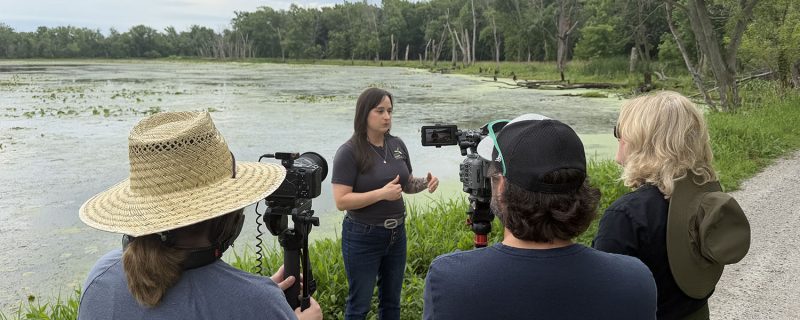
In June 2026, Illinois Public Media’s flagship TV/streaming program, Prairie Fire, brought a crew to northwestern Illinois, including the Quad Cities. They spent two days shooting wetlands footage and interviews with area activists (including PRN’s River Health and Resiliency Coordinator, Nina Struss) who are deeply engaged in wetlands protection and conservation work.
The segment, which was part of the program’s 2026 season premiere in September, dismantled myths and stereotypes about urban wetlands while visually showcasing their beauty—and their function. The importance of education about wetlands was made clear as well, both for members of the community and for influential officials in the region who are in the room when decisions are being negotiated about land and its development.
“When you have community support, anything can really be possible,” Struss notes in the segment. “We can do big things on a small scale. And while when you zoom out it doesn’t necessarily feel like it’s really big, when you zoom in, they’re a really big deal.”
milan bottoms
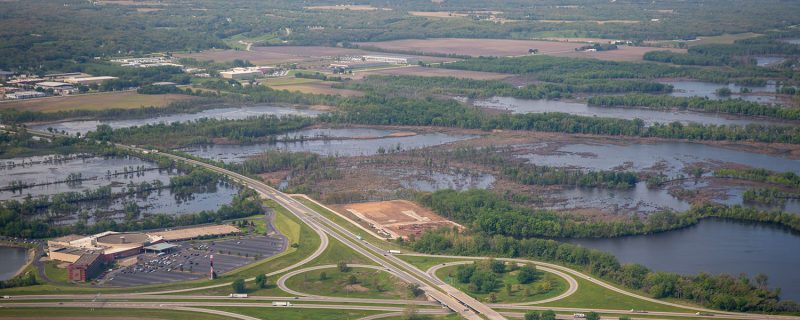
The premiere of Prairie Fire and the wetland spotlight this fall was timely. It aired at a pivotal point for wetland protections in the Quad Cities, including the beautiful wetlands well-known to locals as the Milan Bottoms, located in southwest Rock Island.
PRN has been an integral part of the ongoing process to protect these wetlands, which you can learn more about in our previous blog post, A Hidden Gem at a Crossroads: the Fight to Protect Milan Bottoms. While the development on the 10-acre lot adjacent to the wetlands is moving forward (read more about that here), so is the permanent protection of the remaining 550 acres of wetlands that provide critical flood storage and wildlife habitat to this area.
In July 2025, the City of Rock Island approved an ordinance to move forward with designating these 550 acres of wetlands as a Land and Water Reserve with the Illinois Nature Preserves Commission. Struss was appointed the Chair of the Wetland Task Force, a temporary advisory body established by the City of Rock Island to help guide the protection, management, and long-term stewardship of the Southwest Rock Island Wetlands. Learn more about the task force and this process.
The City of Rock Island continues to work collaboratively with the Illinois Nature Preserves Commission (INPC) to gather all the necessary information for the proposal to submit for approval. This proposal is slated for approval first by the Rock Island City Council in January 2027. Following approval by the City Council, the proposal will be presented to the Illinois Nature Preserves Commission for designation in May 2027.
Finally, Augustana College has worked extensively in the wetlands since April 2026 as part of a collaborative partnership with the City of Rock Island, and remains a critical partner in advancing both ecological research and community engagement for the wetlands. This partnership includes a multi-year inventory of the site’s natural resources, plus community engagement efforts to ensure that future planning efforts are informed by both scientific and community input. Augustana College will hold a public meeting, in collaboration with the Wetland Task Force, in December 2026 to present their 2026 findings.
green valley nature preserve

Just east of the SW Rock Island Wetlands, along the Rock River, sits another wetland complex that provides critical flood storage to residents of the City of Moline and those downstream. The Green Valley Nature Preserve has long been a natural gem to the Quad Cities area. After receiving a nonpoint source pollution control grant (also known as a 319 grant) in 2015, the City of Moline worked alongside several environmental partners to restore prairie and wetlands, and to remove invasive species in the 250 acres. Controlling nonpoint source pollution, which is pollution picked up, carried along, and deposited into waterways by runoff from rainfall or snowmelt, is a crucial part of keeping our rivers clean.
The wetlands at Green Valley not only act as a safeguard when the Rock River reaches flood stage, but are also imperative for the quality of our rivers. When operating correctly, these wetlands provide a vital stop for rain water runoff from businesses on nearby John Deere Road. Runoff that enters the wetlands will leave cleaner as it enters the Rock and Mississippi rivers. These wetlands are an optimal investment for permanent protection.
As luck would have it, grant funding is available again through the Clean River Advisory Council and Quad Cities Community Foundation to support the City of Moline’s desire to permanently protect these wetlands through a conservation easement. Using a collaborative grant approach, the city will work with other environmental and community partners (like PRN), to ensure the easement process is completed and restoration and long-term maintenance is secured.
These hidden gems are the quiet workhorses of the Quad Cities landscape, and deserve to be protected and celebrated/heralded for their beauty and function. “If you would have told me when I started this job that I would become a champion for wetland protection, I probably wouldn’t have believed you,” Struss says. “Other than our QC gem, Nahant Marsh, I didn’t realize we had so many acres of wetlands here on the IL-QC side of the river that are providing critical habitat and flood storage to our communities.
“My hope is that our endeavors continue to travel along the rivers, through our QC communities and the state, as we empower more towns and cities to make decisions that protect these incredible natural resources.”