Topic: Asian Carp

May 4, 2012

Experimental Asian carp barrier fails. We need a real solution.

Today, the multi-million dollar electrical experiment built in the Chicago river system to prevent a full-scale invasion of Asian carp into the Great Lakes failed for thirteen minutes.

You can read about it here.

This is irrefutable evidence that the current regime will not work, and we need a real, permanent solution to stop the carp and protect the Great Lakes. Something we’ve said many times.

Please sign our petition to Stop the Carp!

April 20, 2012

Study Shines Light on How to Stop Carp, Improve the Chicago River

By Robert Hirschfeld

A highly-anticipated report clearly demonstrates that it is possible to separate the artificial connection between the Great Lakes and the Mississippi River basins and prevent the transfer of invasive species through the Chicago River system.

Authored by the Great Lakes Commission and Great Lakes-St. Lawrence Cities Initiative, “Restoring the Natural Divide”  re-envisions the Chicago River as a system which not only prevents the transfer of aquatic invaders such as Asian carp, but also better serves its functions of moving people and goods and managing stormwater, while improving water quality. {Continue Reading »}

February 29, 2012

National Invasive Species Awareness Week: Feb 25 – Mar 3, 2012

It is National Invasive Species Awareness Week. For the past hundred years, man-made canals in the Chicago area have connected Lake Michigan to the Illinois River, creating a connection between the Great Lakes and the Mississippi  River basins. This connection has allowed unwanted aquatic plants and animals to quickly spread between North America’s two greatest freshwater systems. The zebra mussel invaded the Mississippi River and the western US through this pathway, costing taxpayers hundreds of millions of dollars per year in control efforts. Right now Asian carp threaten to move from the Mississippi basin to the Great Lakes, putting a $7 billion/year recreational and fishing industry at risk.

Our top priority right now is to restore the natural separation between the Mississippi River and Great Lakes basins. With quick decisive action we can halt the spread the Asian carp and other species poised to wreak havoc.

More broadly, lawmakers need to get serious about a long-term, comprehensive, and proactive approach to protecting our natural resources from new invasive species. Hitchhiking on the ever-increasing flow of goods and people around the world, transplanted organisms often devastate natural communities where they end up. We need national and international efforts to slow the flood of invasive species that exacerbate already-stressed ecosytems around the world.

January 31, 2012

Press Release: Study Presents Options for Restoring Chicago River & Protecting Lake Michigan

PRESS RELEASE ISSUED: January 31, 2012

River, Lake Advocates Praise New Path Toward Better Flood Control, Cleaner Water, and Keeping Asian Carp Out of Great Lakes

A highly-anticipated report released today clearly demonstrates that it is possible to separate the artificial connection between the Great Lakes and the Mississippi River basins and prevent the transfer of invasive species through the Chicago river system.

The study, Restoring the Natural Divide, offers real alternatives to simply closing the locks between the Chicago River and Lake Michigan. Authored by the Great Lakes Commission and Great Lakes-St. Lawrence Cities Initiative, representing governors and top officials from Great Lakes states, cities, and provinces, the report re-envisions the Chicago River as a system which not only prevents the transfer of aquatic invaders such as Asian carp, but also better serves its functions of moving people and goods and managing stormwater, while improving water quality.

Restoring the Natural Divide offers detailed analysis on three possible separation scenarios and includes a wealth of data on the integration of each scenario with the region’s water infrastructure, as well as an outline and timetable for implementation.

The study was prompted by the urgent need to find a solution to the the ongoing problem of invasive species, including Asian carp. Strong evidence suggests that the threat of Asian carp entering the Great Lakes is imminent and their potential to wreak ecological and economic havoc is real.

While Asian carp have been the public face of invasive species, they are among 39 species deemed “high risk” by the Army Corps of Engineers based on a propensity to invade and to inflict significant damage to new habitat.

Local and Federal Governments currently spend upwards of $200 million per year to control invasive species in the Great Lakes. Ending the continuing threat of transfer of these aquatic invaders through the Chicago River system will be essential to the region’s long-term economic well-being, and would complement plans for river restoration, increasing the value of Chicago’s second waterfront. {Continue Reading »}

January 12, 2012

Asian carp’s watershed moment

carp general1

Follow Robert Hirschfeld on Twitter @PRN_Carp

BY ROBERT HIRSCHFELD

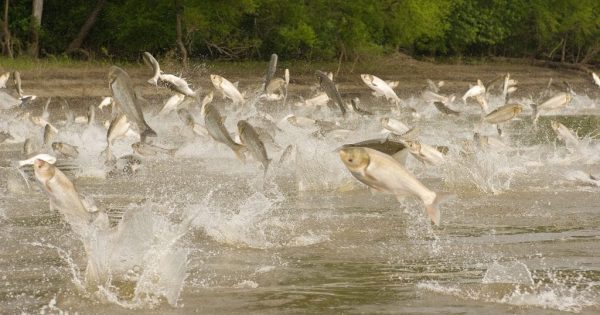
At this moment, there are countless Asian carp steadily making their way northward, swimming upstream throughout the Mississippi River basin, and encroaching into new territory in South Dakota, Minnesota, and most infamously, into the manmade canals on the outskirts of Chicago. These canals connect the Mississippi River basin with a jewel of the Midwest, the Great Lakes.

The Chicago Area Waterway System represents ground zero for the threat of a full-scale Asian carp invasion into the Great Lakes.

Asian carp are well-known as an insidious and malignant invader, outcompeting native species and leaving millions more Asian carp in their wake of disruption.

The fight against Asian carp has reached a critical juncture. The groundwork that is being laid now, by Prairie Rivers Network and our many partners, will help determine the course of an entire region, including its greatest water resources—the Great Lakes and the Mississippi River. {Continue Reading »}

October 7, 2011

Eating Asian carp is a great idea, but nothing like a “solution.”

Robert Hirschfeld
Coalition Organizer – Invasive Species
Prairie Rivers Network

by Robert Hirschfeld,  Coalition Organizer – Invasive Species

In the three weeks since the Illinois Department of Natural Resources announced its plan to fight hunger and Asian carp in one fell swoop, my Asian carp twitter feed has seen more action than in the previous two months combined. #AsianCarp is trending, largely due to the initial disgust* that greets a suggestion of eating river monsters.

Asian carp steaks with Cajun remolade at the Heaven City Restaurant in Mukwonago, WI. Photo courtesy of Gary Porter / Milwaukee Journal Sentinel.

Asian carp steaks with Cajun remolade at the Heaven City Restaurant in Mukwonago, WI. Photo courtesy of Gary Porter / Milwaukee Journal Sentinel.

(I’ve yet to collect the full set of relevant data on what percentage of those adamantly refusing to eat carp don’t think twice about hot dogs. Didn’t your parents ever tell you, “Don’t knock it ‘til you try it”?)

Chicago Tribune columnist Dennis Byrne gets it right when he describes lobsters as “the 19th century equivalent of bigheads.” It has also been said that lobsters are the cockroaches of the sea, and yet it’s a sign of refinement and taste to drop a few bills to rip open their exoskeletons and devour the tasty innards. The superior marketing wizards of the Northeast knew that demand is created from the top down, so you sell it as a delicacy, not some kind of “soylent marine” to be pushed on the masses.

Of course, Mr. Byrne’s ultimate answer is to throw up his arms in disgust at the likely series of unintended consequences that would follow from creating a market for Asian carp. While I take issue with cynicism as the basis for (a lack of) public policy (even in Illinois!), Mr. Byrne is right to be thinking about the logical extension of marketing an invasive species as food.

While humans have driven some species to extinction or endangerment, we have also propped up populations of others to artificially high levels—see chickens, pigs, and cows. Once a profitable industry is established, all the incentives are in place to continue the existence of that industry, even if it trades in a troublesome product. Even if the original purpose of the industry was to exterminate the product. Who will want to end a profitable business—especially in this economy?

Personally, I don’t care if Asian carp are eaten or made into fertilizer for your garden. I’m happy to see them pulled out of the rivers they currently infest, and I’m thrilled to decrease the pressure on the experimental electric “barrier” which is currently serving as the last line of defense against a full-scale Asian carp invasion in the Great Lakes.

Still, Illinois needs to think carefully about its approach on this issue. If the state can successfully sell Asian carp as a healthy, protein-rich, and delicious food, then it should do so. But it should not forget that this is a means to an end—removing the threat of Asian carp.

Which brings me to the deeply buried lead. Asian carp represents only the most visible invasive species threatening our rivers and lakes.  The US Army Corps of Engineers has identified 39 (yes 39!) high-risk invasive species poised to use the Chicago Waterway System to infest the Great Lakes and Mississippi River basins. You can eat all the carp you want (and as they are delicious, I encourage you to do so), but that will not end the threat of invasive species. A real solution can only take the shape of a permanent, physical barrier separating the Great Lakes and Mississippi River watersheds.

Fish infected with VHS. Photo courtesy of WI DNR.

Fish infected with VHS. Photo courtesy of WI DNR.

As for the dozens of other invasive species, they’re unlikely to have a place at the table. I assure you, no one is going to want to eat Viral Hemorrhagic Septicemia. And unlike the initial aversion to carp, that is a very rational response.

* The reaction to Asian carp appears to be based on association with the “trash fish” Common carp. Unlike Common carp, Asian carp feed on plankton from the middle of the water column, making them a cleaner-tasting fish and keeping them low in toxins like mercury that can bioaccumulate in fish like tuna.